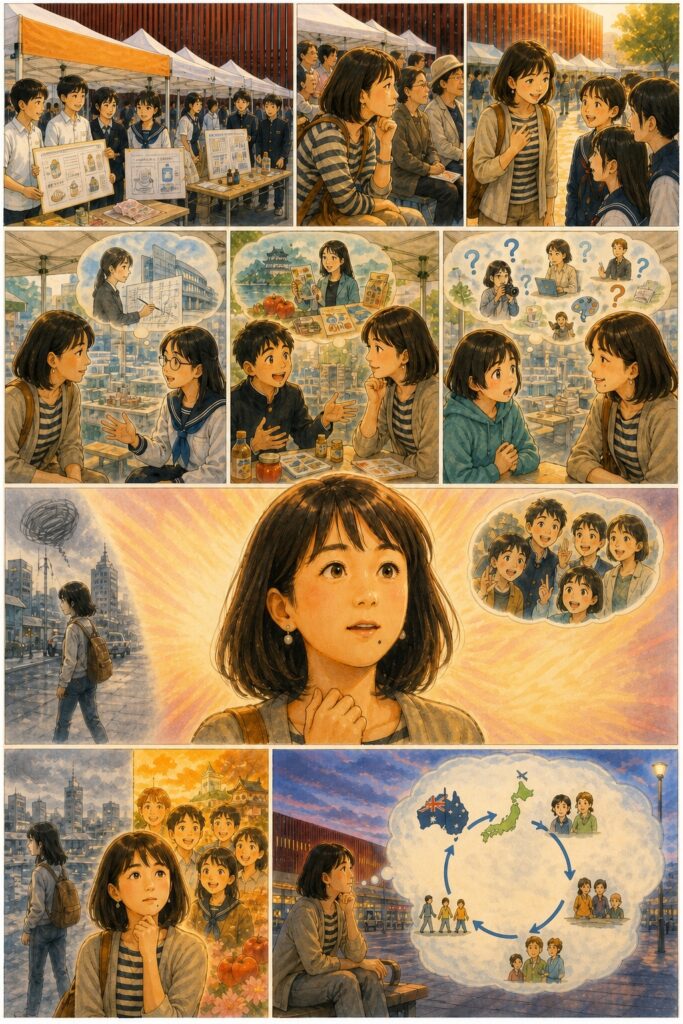
They were divided into several groups,
each presenting their own ideas
for Aomori souvenirs.
They explained
who they wanted to sell them to,
what they would sell,
and how they would sell them —
almost like a marketing presentation.
I wanted to know
what junior high school students
these days were thinking about,
so after listening to
all the presentations,
I asked a few of them
some questions.
“I’ve just come back
from overseas,
and I don’t really have many chances
to talk with junior high school
students now...
Would you mind telling me
what kind of things
you think about?
Do you have any dreams?”
One girl said,
“I want to become an architect
and build something here
in Aomori.”
Another student said,
“I want to work for Aomori’s
tourism department
and develop local souvenirs.”
There was also a student
who said,
“I still don’t know
what I want to do yet,
so that’s why I’m joining
this kind of program.”
They wanted to do something
in Aomori.
Aomori.
Aomori.
Aomori.
I remember thinking,
“Wow...
Aomori is passionate.
Aomori is amazing.”
As someone who had never felt
that strong a sense of love
for my own hometown,
Hachioji,
I was honestly shocked.
And for some reason,
I felt that I wanted to do work
that involved children
around this age.
I thought again:
It is good to go overseas
at least once.
By looking at Japan objectively
from the outside,
you can see more clearly
what is good about Japan,
and also what we need
to be careful about
and think through
more deeply.
Then,
when each person comes back,
they can return something
to Japan
in their own way.
I know I am repeating myself,
but in the end,
the feeling was the same.
37